
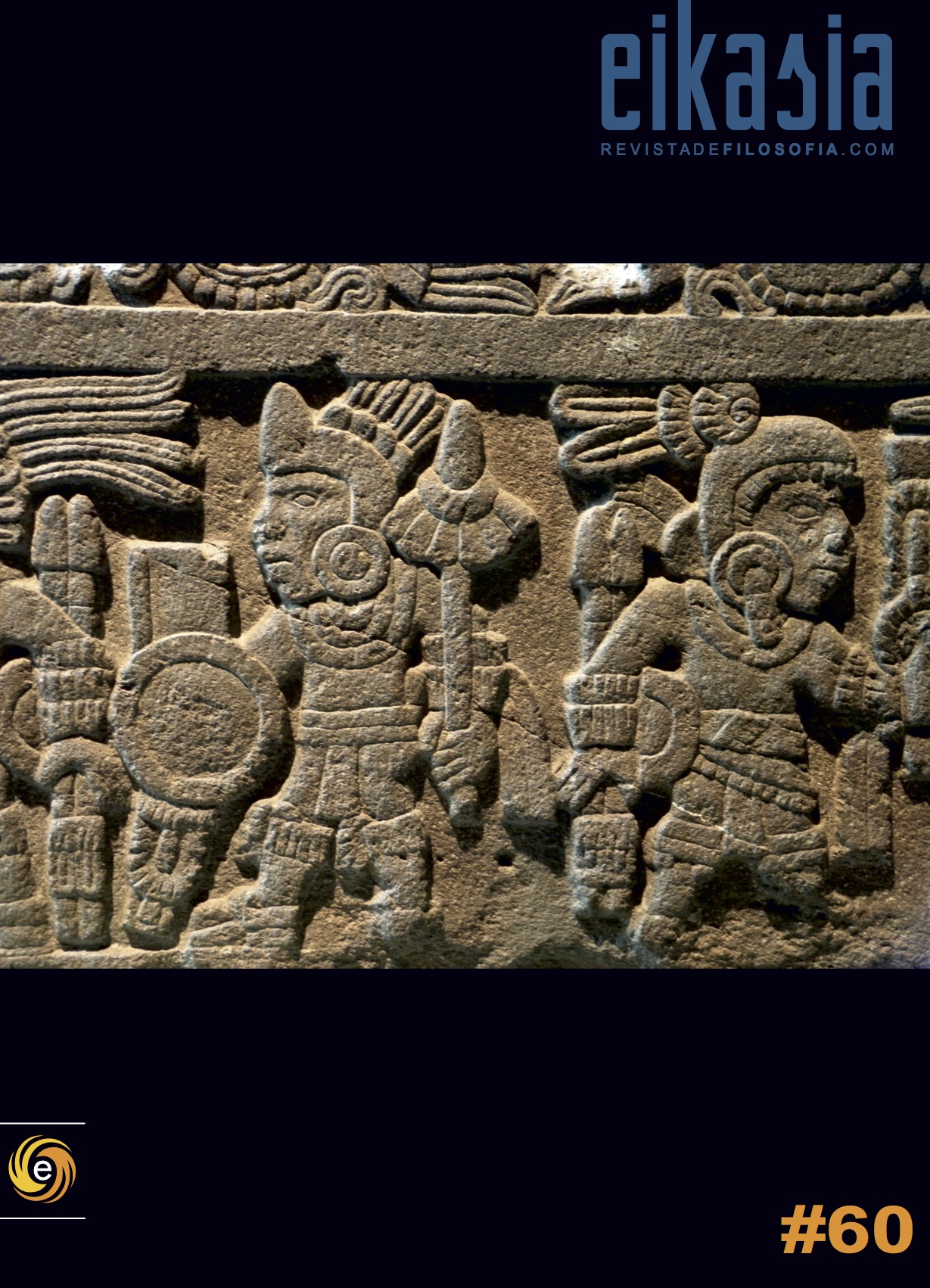
Esencias  salvajes  y  existencia  de  los  derechos  humanos. Primera  Parte.  Elucidación  conceptual  sobre  el  sentido  de  la expresión  en  Merleau-­‐‑Ponty.
PDF (Español (España))

Keywords

Esencia salvaje, existencia, derechos humanos, interculturalidad, realismo constructivo, fenomenología, carne, estromatología, organizaciones internacionales, instituciones simbólicas, trans-operaciones, egología trascendental, Leib, Cogito. Wild Essence, existence, human rights, multiculturalism, constructive realism, phenomenology, meat, estromatología, international organizations, symbolic institutions, trans-operations, transcendental egologie , Leib, Cogito.

How to Cite

Hidalgo Tuñón,A. (2026). Esencias  salvajes  y  existencia  de  los  derechos  humanos. Primera  Parte.  Elucidación  conceptual  sobre  el  sentido  de  la expresión  en  Merleau-­‐‑Ponty. Eikasía Revista De Filosofía, (60), 61–100. https://doi.org/10.57027/eikasia.60.1941

Abstract

The exoteric problem, but no less

provocative, which posits the existence of a

wild essence of human rights is highly topical

facing two issues. 1 - The issue of intercultural

foundation of human rights in this post-

Marxist era in bourgeois individualism that is

rampant denying legitimacy to collective

rights. And 2 - called the issue of animal rights

whose cause has been revived in our time by

many philosophers, including Peter Singer

with his book Animal Liberation, which places

the scope in borders of the species. Regarding

the first question, it is known that many

civilizations did not know or at least did not

recognize any formal code or eidetic picture of

Human Rights for human beings qua such,

though they do seem to take noted certain

limits or ethical prohibitions under the name of

explicit commands or ancestral traditions in

human relationships. It is proverbial in the

twentieth century the resistance put China to

sign the ratification of the Universal

Declaration of Human Rights United Nations,

even though they had signed in 1948 and part

of its Security Council veto, claiming in 1993

the Confucian tradition. The second question

raises the issue of whether only sensitive

human body (Leib) have rights and why not

the animals. The animals have souls, but have

Leib?

1 Al objeto de ampliar y matizar los problemas

aludidos, el artículo se completará con dos entregas

más, para cuya redacción definitiva contaré con la

colaboración de los doctores D. José Antonio

Méndez Sanz y D. Armando Menéndez Viso, del

Departamento de Filosofía. Tentativamente se

titulan así:

Segunda parte: Interculturalidad de los derechos

humanos: el caso de China.

Tercera Parte: Inter-especificidad de los derechos

humanos: trasfondo fenomenológico de la disputa

sobre los derechos de los animales y filosofía

preventiva.

Well, two problems regarding the

hypothetical, and perhaps contradictory

existence of a wild essence of human rights

poses no problems and conflicts similar to

those of the theological foundation of the

same, but much more philosophically radical

as the resurrected question of the legitimacy of

cultural relativism to resisting unilateral

impositions of dominus at the same level of the

boundary between human and non-human to

the extent that compromises the specificity of

the human body. In both cases it is shown how

the different human sciences left open

gnoseologically philosophical sides, which is

not without connections to the fact that the

argument of the superiority of Western

civilization on other cultures or civilizations is

increasingly tenuous and the perennial need to

return to a phenomenological foundation of

anthropology, since in both cases calls into

question the natural attitude. Now the use of

wild Wesen Merleau Ponty directly affects the

evolution it looks implied philosophical

materialism since the Congress of Murcia and

at present uses the Estromatología given by

Ricardo Sánchez Ortiz de Urbina. But

estromatología only serve as a scaffold for

eidetic essences would observe herself dam of

transcendental egologie whose dimension

intended confines. For if the essence could

only be eidetic, then all of them depend on the

constitutional thought and would not object

nor real world to discover beyond the Cogito.

In this first part, which will continue other two, we elucidate the preliminary question of the meaning of wild Wesen in Merleau-Ponty.

https://doi.org/10.57027/eikasia.60.1941
PDF (Español (España))
Creative Commons License

This work is licensed under a Creative Commons Attribution-NonCommercial-NoDerivatives 4.0 International License.

Copyright (c) 2014 Asociacion de Filosofía Eikasía

Downloads

Download data is not yet available.